
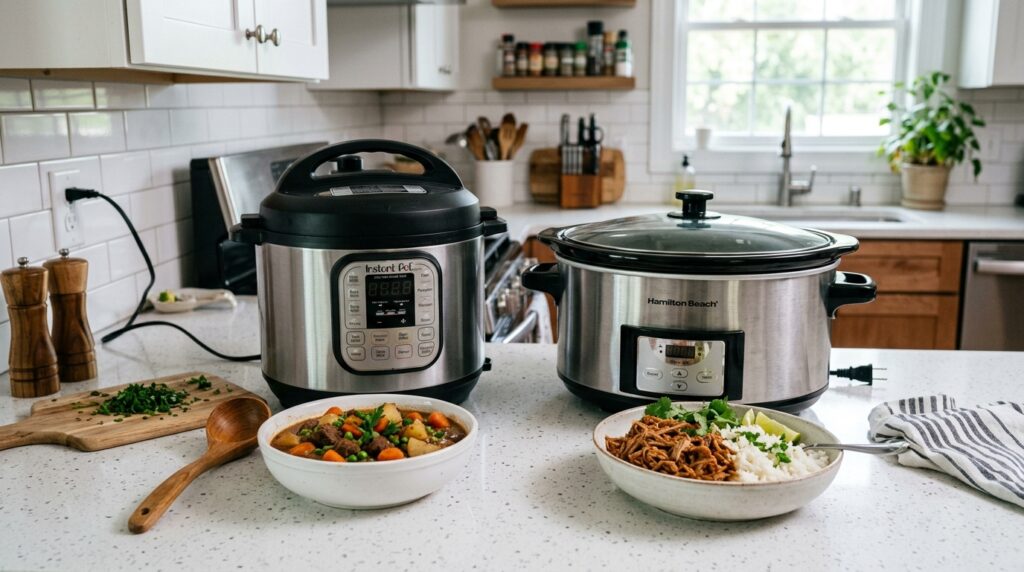
If you are considering a kitchen appliance that saves time, eases meal preparation and assists to cook delicious homemade meals, you’ve probably narrowed your choices to two options: the Instant Pot and the Slow Cooker.
The two options cater to entirely different cooking styles and daily routines. The Instant Pot promises fast, pressure-cooked meals in a fraction of the usual time, while the slow cooker relies on gentle, hands-off, “set-it-and-forget-it” cooking over several hours.
Below is a quick comparison,
| Feature | Instant Pot (Multi-Cooker) | Slow Cooker (Crock-Pot) |
| Primary Cooking Method | High-Pressure Steam | Low, Steady Heat Conduction |
| Cooking Speed | Very Fast (Minutes) | Slow (Hours) |
| Ease of Use | (Slight Learning Curve) | (Dump & Go) |
| Meal Variety | (Sauté, Steam, Bake, Pressure) | (Stews, Roasts, Soups) |
| Pressure Cooking | Yes | No |
| Sauté / Browning Function | Yes (In the same pot) | No (Requires a separate skillet) |
| Rice Cooking | Excellent | Fair / Inconsistent |
| Yogurt & Fermentation | Yes (Select models) | No |
| Energy Efficiency | High (Short run times) | High (Low wattage run longer) |
| Best For | Busy weekends, meal preppers, small spaces | Busy workdays, traditional comfort food lovers |
The Instant Pot
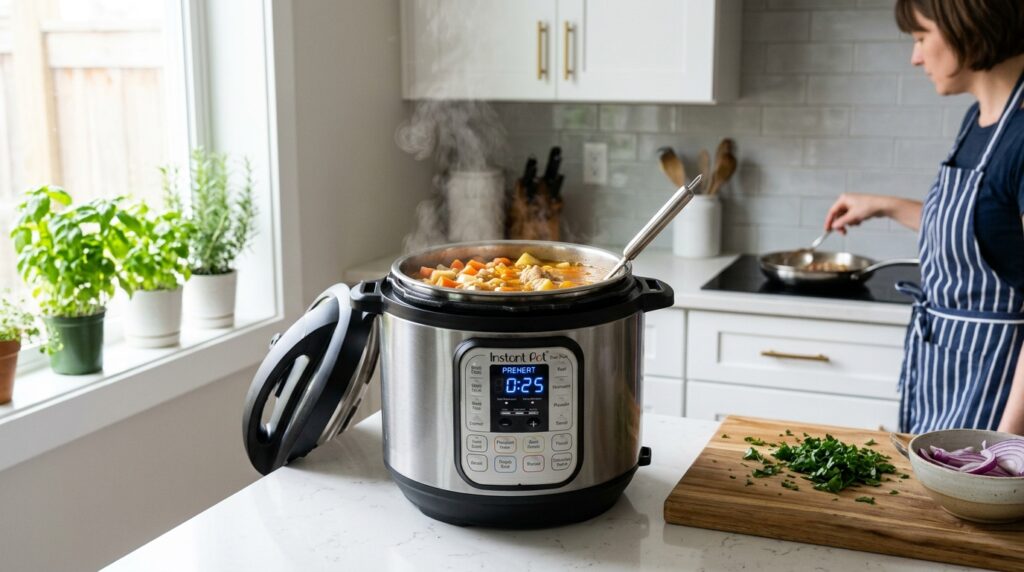
The Instant Pot is a device designed to perform the functions of up to 10 traditional kitchen appliances in one unit.
It functions by accumulating steam inside an airtight pot. As the steam builds, internal pressure increases, raising the boiling point of liquid. This high-heated environment cooks food up to 70% faster than traditional stovetop methods while locking in moisture.
Main Functions Offered by Most Models:
| Electric Pressure Cooker | Fast beans, roasts, soups |
| Slow Cooker | Low and high settings |
| Rice Cooker | Grain Maker |
| Sauté / Browning Pan | Brown meat directly in the inner pot) |
| Steamer | Vegetables, seafood, dumplings |
| Yogurt Maker | Temperature-controlled fermentation |
The Slow Cooker
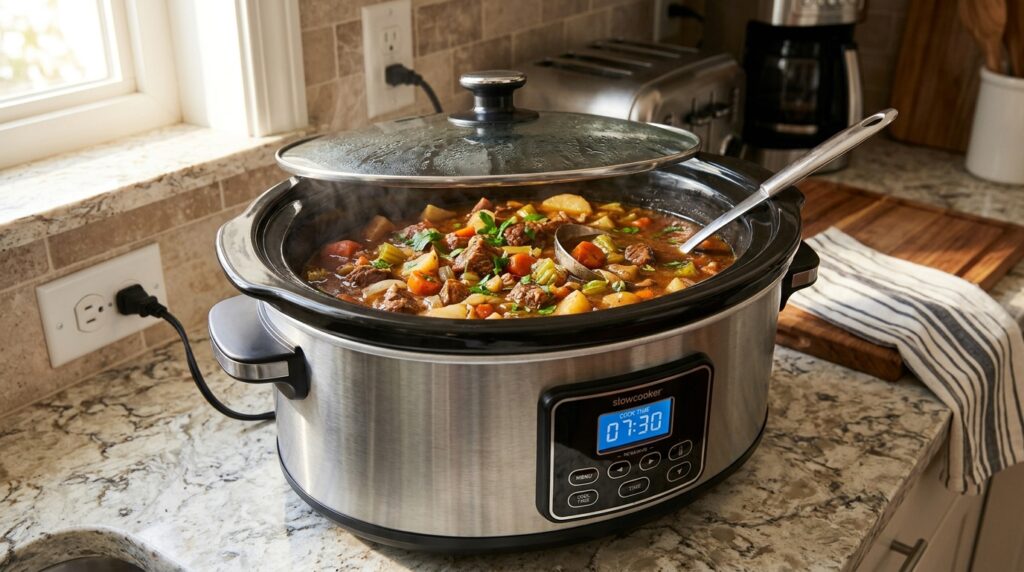
A Slow Cooker is also referred to as a Crock-Pot. It is an electric appliance featuring a heavy ceramic or stoneware crock fitted inside a heating element.
Food cooks evenly at a low temperature i.e. 175°F and 215°F for over 4 to 10 hours. Heat radiates up the sides of the crock, making hard and tough pieces of meat, collagen, and root vegetables to become tender and flavorful without scorching
Meals recommended for a Slow Cooker are:
- Tender pulled pork and shredded chicken
- Beef brisket, chuck roasts, and pot roasts
- Hearty chilies and vegetable soups
- Slow-simmered bone broths and marinara sauces
- Warm dessert bakes and fruit cobblers
One on One Comparison
1. Speed & Time Saving
Instant Pot: Pressure cooking fundamentally changes your weeknight schedule. Frozen chicken breasts cook in about 10–12 minutes, dry beans in 30–35 minutes, and a complete beef stew in under 45 minutes. Note: You must factor in 5 to 15 minutes for the pot to come to pressure, plus pressure release time
Slow Cooker: Designed for patience rather than speed. Standard recipes take 4–6 hours on High or 7–10 hours on Low. It won’t save you time right before dinner, but it allows you to start cooking hours in advance
Best Choice: Instant Pot
2. Food Texture & Flavor Development
Slow Cooker: Long, slow simmering allows deep flavor extraction, especially in collagen-heavy cuts of meat (like shoulder or chuck). As the collagen melts into gelatin over 8 hours, it creates a rich, silky mouthfeel that is hard to replicate quickly.
Instant Pot: Traps steam and aromatics effectively, forcing liquid into foods quickly. While meals are extremely juicy, sauce reduction can be tricky because steam cannot escape. You often need to use the Sauté function at the end to thicken sauces.
Winner: Slow Cooker for traditional roasts and deep flavor fusion; Instant Pot for moist poultry and tender grains.
3. Kitchen Versatility & One-Pot Cooking
Instant Pot: Features a built-in Sauté function. You can sear beef, caramelize onions, or bloom spices directly in the stainless steel liner before switching over to pressure cooking. You can also cook rice, bake cheesecake, and ferment yogurt.
Slow Cooker: Lacks a high-temperature sear feature (with a few expensive hybrid exceptions). If a recipe requires browning meat first, you must use a separate stovetop skillet, adding an extra pan to clean.
Winner: Instant Pot.
4. Ease of Use & Learning Curve
Slow Cooker: Exceptionally straightforward. Dial settings usually consist of High, Low, Warm, and an optional timer. It is almost impossible to overcook liquid-heavy dishes.
Instant Pot: Features digital control panels, float valves, silicone rings, and steam vents. Beginners often face an initial “pressure anxiety” step and must learn terms like Natural Pressure Release (NPR) vs. Quick Release (QR).
Winner: Slow Cooker.
5. Cleaning & Maintenance
Slow Cooker: Consists of three parts: the outer base, the heavy ceramic crock, and the glass lid. The crock and lid are dish washable and easily wiped clean.
Instant Pot: The inner stainless pot is dishwasher-safe. However, the lid houses complex components—a rubber sealing ring (which can absorb food odors), a steam release valve, an anti-block shield, and a condensation collector—that require periodic manual disassembly and thorough washing.
Winner: Slow Cooker.
6. Energy Consumption
Slow Cooker: Uses between 150 and 250 watts per hour over an 8-hour stretch (~1.2 to 2.0 kWh per meal).
Instant Pot: Operates at 700 to 1,000 watts, but draws peak power primarily while reaching and maintaining pressure for short spans (30–45 minutes total, consuming ~0.5 to 0.8 kWh per meal).
Winner: Tie (Both cost only pennies per meal compared to running a full-size 3,000-watt electric oven).
Final Verdict Summary
| Category | Winner |
| Speed | Instant Pot |
| Versatility | Instant Pot |
| Meal prep | Instant Pot |
| Ease of use | Slow Cooker |
| Slow-cooked flavor | Slow Cooker |
| Large family meals | Slow Cooker |
| Kitchen flexibility | Instant Pot |
| Overall | Instant Pot |
Frequently Asked Questions
Which one is better, an Instant Pot or a slow cooker?
Most people prefer an Instant Pot because it can perform several cooking functions. However, a slow cooker can be better for people who prioritize simplicity and traditional slow-cooked meals.
Can an Instant Pot replace a slow cooker?
Yes. Many Instant Pot models include a slow-cooking function. However, dedicated slow cookers may still be preferable if slow cooking is your primary cooking method.
Is it worth to buy a slow cooker in 2026?
Yes. Slow cookers remain useful for preparing soups, stews, chili, pulled pork and other meals with minimal hands-on effort.
Which is better for beginners?
A slow cooker is generally easier for beginners because it has fewer settings and requires less interaction.
Which is better for meal prepping?
The Instant Pot generally has the advantage because its multiple cooking functions allow you to prepare a wider variety of foods.
What size Instant Pot should I buy?
A 6-quart model is a practical choice for many households and meal-prep needs. Larger households may prefer a bigger capacity model.
What size slow cooker should I buy?
A 6- to 7-quart slow cooker is a useful choice for families and larger batches of food.
Final Recommendation
If you’re still undecided, here’s the easiest way to choose:
Need speed and versatility? → Instant Pot
Want simple, slow cooking? → Slow Cooker
Want one appliance to do more jobs? → Instant Pot
Want an easy “set it and forget it” appliance? → Slow Cooker
Want the best overall option for 2026? → Instant Pot
Affiliate Disclosure
Modern Home Choice participates in affiliate programs, including the Amazon Associates Program. This means we may earn a commission when you purchase products through links on our website, at no additional cost to you. Our recommendations are based on product features, usefulness and suitability for different types of home cooks.